
How do you follow up on a cold email?
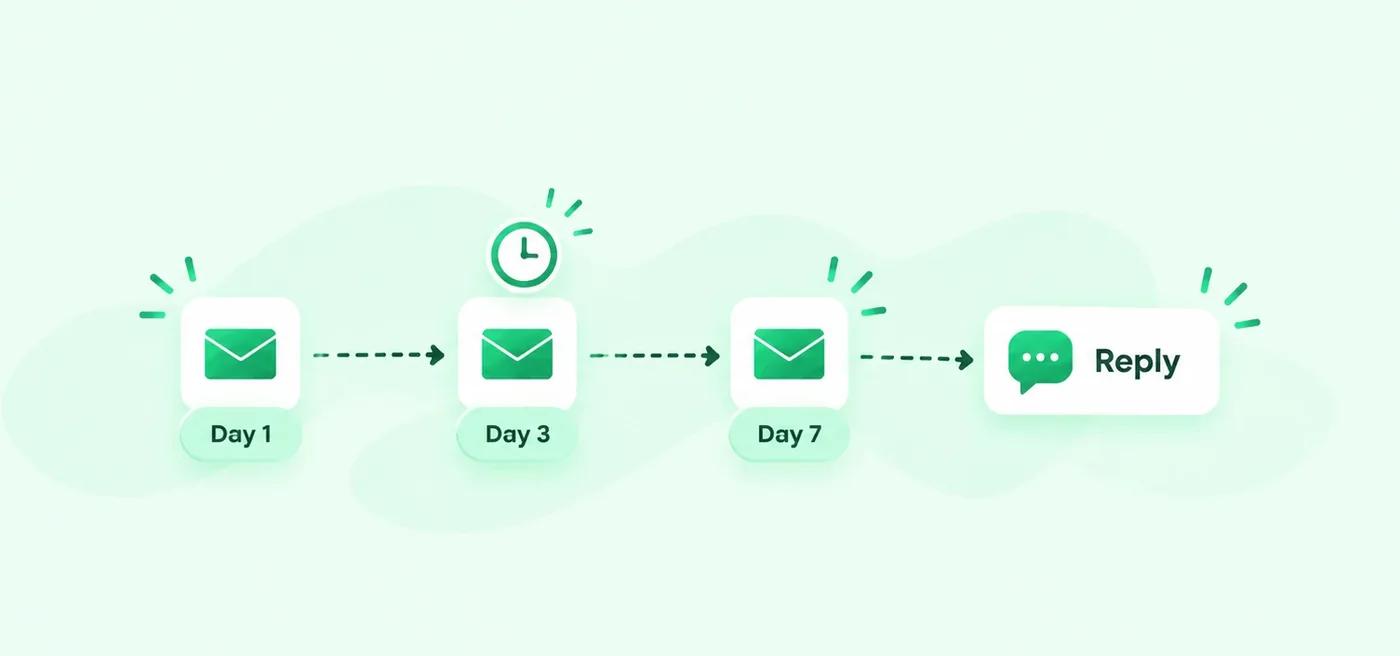
Wait three to four business days after your first email, then reply in the same thread with something new: a different angle, a short example or an easier question. Send three to five emails in total, space the later ones further apart, and stop with a short break-up email. Never send "just checking in".
Most replies to cold outreach do not come from the first email. People are busy, the message gets buried and a well-timed second touch is often what gets an answer.
This guide covers timing, how many follow-ups to send, what to write, four templates and the mistakes to avoid. It builds on our guide to writing a cold email.
When to send the first follow-up
Wait three to four business days after the first email. That is long enough that you are not nagging, and short enough that your first message is still fresh in the inbox.
Send it as a reply in the same thread, so the prospect sees your original note right below it. A new thread loses that context and looks automated.
How many follow-ups to send
Three to five emails in total, including the first one, is a sensible range for most B2B campaigns. Space the later touches further apart: a few days between the first two, then closer to a week between the last ones.
Stop when the sequence ends. A prospect who has seen four relevant emails and not replied has told you something. Move them out of the sequence and come back in a quarter, or when something changes at their company.
What to write in each follow-up
A follow-up earns its place only if it adds something the first email did not. Each one should do one of these:
Keep each follow-up shorter than the one before it. Three or four short lines beat a second full pitch.
An example four-email sequence
Cold email follow-up templates
Replace every bracket with something real. If you cannot, do not send that email.
Follow-up 1: a new angle Subject: Re: [original subject] Hi [First name], One more thought on [problem]. Teams like [Company] often find that [specific insight]. If that is useful, I can share how we would approach it for you. [Name]
Follow-up 2: a short example Subject: Re: [original subject] Hi [First name], A quick example: [one line about a similar customer or situation, only if it is real]. Would a short outline for [Company] be useful? [Name]
Follow-up 3: a resource and an easier question Subject: Re: [original subject] Hi [First name], Putting this here in case it helps: [short resource or checklist]. No reply needed, but if [problem] is on your list, who is the right person to talk to? [Name]
Follow-up after no response: the break-up email Subject: Re: [original subject] Hi [First name], I have not heard back, so I will assume [topic] is not a priority right now and will stop emailing. If that changes, just reply here and I will pick it up. [Name]
The follow-up email after no response
If you have had no response after several emails, the answer is usually timing, relevance or deliverability, not rudeness. Work through these in order:
Then send the break-up email from the templates above and move on.
Break-up emails
The break-up email is often the one that gets answered, because it removes the pressure. Keep it to two or three sentences, make it easy to say "not now" and do not guilt-trip. A good one is polite, brief and leaves the door open.
Follow-up subject lines
Replying in the same thread keeps the original subject with "Re:", which is usually best for the first few follow-ups. If you start a fresh subject for a later touch, keep it short and specific, not a repeat of "Following up". Avoid false "Re:" prefixes on emails that are not replies, because they hurt trust.
Should you follow up on another channel?
Often yes. A short LinkedIn connection or message between emails can lift the chance of a reply, because the prospect sees your name in two places. Keep the tone consistent and do not repeat the same message everywhere. For how to run that side, see our guide to LinkedIn lead generation.
Follow-up mistakes to avoid
Starting a new thread each time
it loses the context of your first email and looks automated.
Repeating the same pitch
if the first email did not land, the same words will not land the second time.
Following up too fast
daily emails read as pressure, not persistence.
Writing "just checking in"
it adds nothing and gives no reason to reply.
Ignoring deliverability
follow-ups only work if the first email reached the inbox. Verified lists and a properly warmed sending setup matter before you write a single follow-up.
Ignoring opt-outs
always honour unsubscribe requests quickly.
How to measure your follow-ups
Do not judge a sequence by open rates, which are unreliable. Track:
If most replies come from one step, test that angle in an earlier step.
What good looks like
In our founders' campaigns, reply rates typically range from 25% to 35% on LinkedIn and cold email, and well-built follow-up sequences are a big part of that. The figure varies by ideal customer, market and offer.
If you would rather have this run for you, see our cold email agency service. For the wider picture, see our guide to B2B lead generation strategies.
Frequently asked questions
How long should you wait to follow up on a cold email?
Three to four business days for the first follow-up, then a few days between the next one or two, and closer to a week between the last ones.
How many times should you follow up on a cold email?
Three to five emails in total, including the first, is a sensible range for most B2B campaigns. Stop when the sequence ends and come back later.
What should a follow-up email say?
Something new: a different angle, a short real example, a useful resource or an easier question. Never just "checking in".
Should I reply in the same thread?
Yes for most follow-ups. It keeps the context and looks like a real person, not an automated sequence.
What is a break-up email?
A short, polite final email that tells the prospect you will stop emailing and makes it easy to say "not now". It often gets a reply because it removes the pressure.
What if I get no response at all?
Check deliverability, the list and the clarity of your first email, then change the angle. If there is still no reply after the full sequence, stop and revisit in a few months.
Can I follow up on LinkedIn as well?
Yes. A short LinkedIn touch between emails can help, as long as you do not repeat the same message everywhere.