
What are the best B2B lead generation strategies?
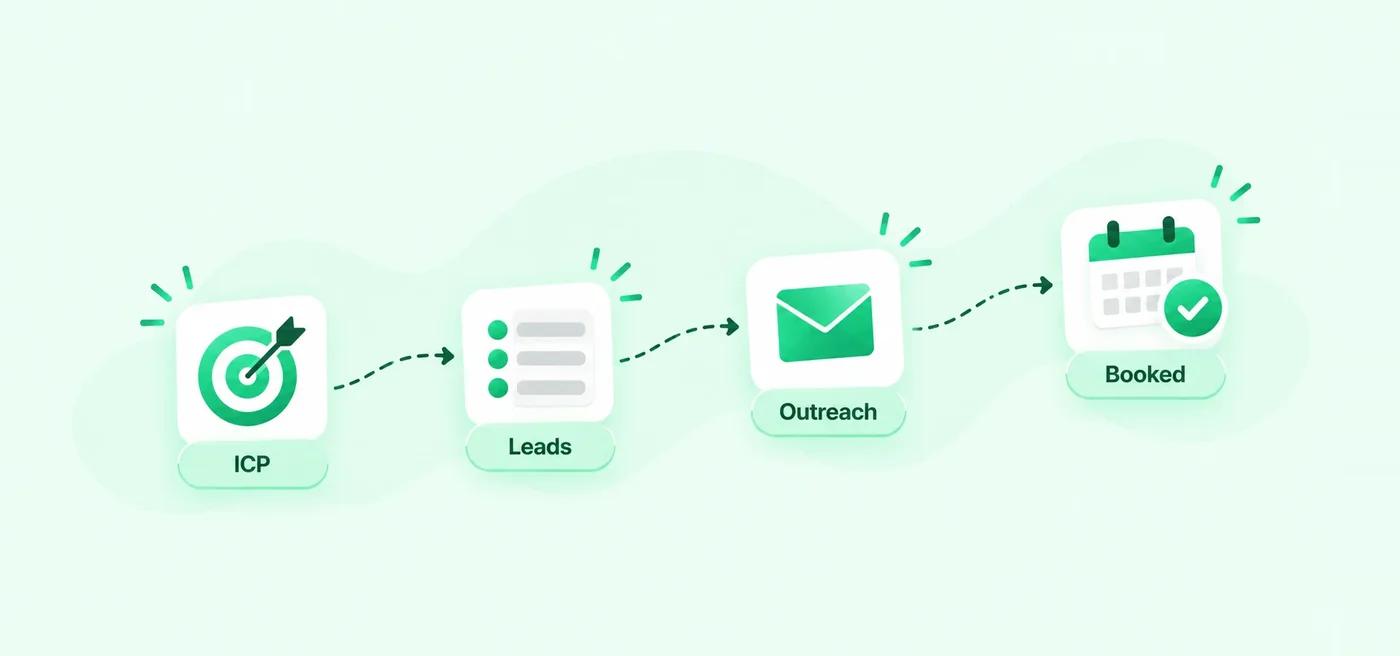
The best B2B lead generation strategy starts with a tight ideal customer profile (ICP): define who is worth contacting, build a verified list of them, then reach them across channels with a message that fits their situation. After that, the strategies that work most reliably are outbound (cold email, LinkedIn and appointment setting), content and search, and referral and partner channels.
This guide covers the ICP foundation first, then 15 strategies you can use, how to choose between them, a 90-day plan and how to measure results.
15 B2B lead generation strategies
Start here: your ideal customer profile (ICP)
Every strategy below depends on targeting, so define your ICP before you pick a channel.
What is an ICP and why it matters
ICP stands for Ideal Customer Profile. It is a precise description of the type of company, and person within that company, most likely to buy from you, get value from your product, stay long-term and refer others.
Most B2B companies have a loose version of this: "mid-market SaaS companies" or "professional services firms with 50 to 200 employees." That is not an ICP. That is a market segment.
A real ICP is specific enough that when you see a company on LinkedIn, you can decide in 10 seconds whether they are worth reaching out to. If your ICP requires a conversation to evaluate, it is not tight enough.
Why does this matter? Because every campaign variable (your list, your messaging, your channel, your timing) is downstream of targeting. Fix targeting first and everything else improves.
The four signals of a high-fit prospect
Across hundreds of B2B campaigns, four signals consistently predict whether a prospect will convert:
1. Company size matches your delivery model
A 10-person startup has different buying behaviour, budget cycles and decision-making speed than a 500-person enterprise. Know which size you close best and filter ruthlessly for it.
2. They have the problem you solve, right now
Timing is the most underrated targeting factor. A company that just raised a Series B, hired a VP of Sales or expanded into a new market is far more likely to need outbound support than one in a stable phase. Use intent signals to find prospects in motion.
3. The decision-maker has budget authority
Reaching the right company but the wrong person wastes everyone's time. Map out who owns the budget for your solution. It is often not the person with the most relevant job title.
4. They have bought similar solutions before
A company already using a complementary tool or a competitor's product has already validated the problem. They are not a cold prospect, they are a warm one with an existing budget line.
How to build your ICP from existing customers
The fastest way to define your ICP is to look backwards at your best existing customers. Pull your top 10 clients, the ones with the highest lifetime value, lowest churn and most referrals, and ask:
Look for the patterns. If seven of your ten best clients are B2B SaaS companies with 50 to 150 employees, a sales team of 5 to 15 people and a recently hired Head of Growth, that is your ICP.
Turning your ICP into a lead list
Once your ICP is defined, building a list is a research and filtering problem, not a creative one.
For LinkedIn-based lists, use Sales Navigator filters to target by company size, industry, seniority, geography and posted content. Export the results and verify emails before any outreach.
For intent-based lists, tools like G2, Bombora and Apollo surface companies actively researching solutions in your category. These prospects are already in buying mode. They just have not found you yet.
Clean your list before you contact anyone. Remove personal email addresses, companies outside your ICP on second look, and anyone who has been contacted in the past 90 days. A smaller clean list always outperforms a large messy one.
The 15 strategies in detail
Strategy 1: Cold email outreach
Cold email is still one of the most direct ways to start a B2B conversation, because you choose exactly who receives your message. It rewards tight targeting, short messages and a short follow-up sequence, and it depends on good deliverability. See our guides to writing a cold email and cold email follow-ups, or our cold email service.
Strategy 2: LinkedIn outreach
LinkedIn lets you reach senior decision-makers by role, company and industry, with your profile and content backing up every message. Connection limits mean volume is capped, so targeting and message quality matter more. See our guide to LinkedIn lead generation or our LinkedIn service.
Strategy 3: Appointment setting and outsourced SDRs
If you want booked meetings without building a team, appointment setting and outsourced SDRs put trained people on outreach, replies and qualification. Appointment setting books qualified calls from outreach we run for you. An outsourced SDR is a dedicated rep working in your tools. Read what an SDR is, or see our appointment setting and outsourced SDR services.
Strategy 4: Multichannel outbound
Running email, LinkedIn and phone as one coordinated sequence tends to beat any single channel, because prospects see your name in more than one place. The key is consistency of message and a single view of replies. See our outbound lead generation service.
Strategy 5: Account-based marketing (ABM)
ABM treats a short list of high-value accounts as markets of one. You pick the accounts, map the buying team and run coordinated, personalised outreach and content to each. It suits larger deal sizes and longer sales cycles, and works best when sales and marketing agree on the target list.
Strategy 6: Intent data and trigger events
Intent data and trigger events show you who is likely to need you now. Triggers include a funding round, a new executive, a hiring spree, a product launch or a tool change. Intent tools such as G2, Bombora and Apollo show companies researching your category. Use these signals to prioritise the list and to give your first message a real reason to exist.
Strategy 7: Content marketing and SEO
Helpful content that ranks in search brings in buyers who are already looking for answers. Focus on the questions your best customers asked before they bought, and write for specific, commercial topics, not general ones. It is slower than outbound, but it compounds. See our AI SEO service and our content service.
Strategy 8: AI search visibility
Buyers now ask ChatGPT, Perplexity and Google's AI answers for vendor suggestions. To appear, you need clear, quotable answers on your own site, a consistent brand name and mentions on trusted third-party sites such as review sites, lists and communities. Treat it as an extension of SEO. See our AI SEO and GEO service.
Strategy 9: LinkedIn content and personal branding
Founders and team members who post useful content about their buyers' problems warm up prospects before any outreach lands. Consistency matters more than viral reach. Our LinkedIn ghostwriting and content service can handle the writing.
Strategy 10: Referrals
Referrals from happy customers usually convert well, because trust comes with them. Make it easy and natural: ask at moments of success, say exactly who you want to meet, and thank people properly. A simple referral process beats an occasional awkward ask.
Strategy 11: Partnerships and co-marketing
Companies that sell to the same customers but do not compete can introduce each other, run joint webinars or publish joint content. Choose partners whose audience matches your ICP, and agree what each side will do and how leads are shared.
Strategy 12: Webinars, events and communities
Webinars, events and online communities put you in front of buyers who are actively learning. Pick a narrow topic, share something genuinely useful and follow up personally with attendees. In communities, contribute before you promote.
Strategy 13: Lead magnets and gated content
A lead magnet, such as a checklist, template, benchmark report or calculator, trades something useful for contact details. It works when the asset solves a real problem for your ICP and the follow-up is relevant. Gating everything lowers reach, so keep your best educational content open and gate the tools and templates.
Strategy 14: Review sites and directories
Many buyers shortlist vendors from review sites and directories such as G2, Capterra and Clutch before they speak to anyone. A complete profile with real customer reviews can turn that research into leads. Do not fake reviews or buy them.
Strategy 15: Website conversion and follow-up
Leads from every channel land on your website, so make it easy to act: a clear offer, a short form or booking link, fast pages and proof. Then follow up quickly. A prospect who has to wait days for a reply has usually moved on.
How to choose the right strategies
You do not need all 15. Choose by stage, deal size and capacity.
Early stage
Start with a tight ICP and one or two outbound channels, usually cold email and LinkedIn, plus referrals from your first customers. They need little budget and give fast feedback.
Growing
Add multichannel outbound, appointment setting or SDRs for capacity, and content and review sites to build compounding demand.
Established
Layer ABM for high-value accounts, partnerships, events and AI search visibility, while keeping outbound running.
Whatever you choose, run fewer channels well before adding more.
A simple 90-day plan
Many clients see their first booked meetings within two to four weeks of launch, depending on ideal customer size and offer.
How to measure B2B lead generation
Track the whole funnel, not just lead counts.
Judge each channel on pipeline, not volume.
ICP mistakes that kill campaigns
What good looks like
In our founders' campaigns, reply rates typically range from 25% to 35% on LinkedIn and cold email. The figure varies by ideal customer, market and offer. The consistent factors are a tight ICP, a verified list, personalised messaging and consistent follow-up.
If you would rather have this run for you, see our B2B appointment setting service or all of our B2B lead generation services.
Frequently asked questions
What is B2B lead generation?
B2B lead generation is the process of finding and attracting potential business customers and moving them toward a sales conversation. It covers outbound methods such as cold email and LinkedIn outreach, and inbound methods such as content, search and referrals.
What is the best B2B lead generation strategy?
There is no single best strategy, but the most reliable starting point is a tight ICP with outbound outreach through cold email and LinkedIn, because you control who you reach. Add content and referrals for longer-term demand.
How long does B2B lead generation take to work?
Outbound can produce meetings within a few weeks of launch. Content and SEO usually take months to build. Results vary by ideal customer, market and offer.
What is the difference between inbound and outbound lead generation?
Inbound attracts people who come to you through content, search and referrals. Outbound means you contact chosen prospects directly. Most strong programmes use both.
How often should I update my ICP?
Review it every quarter. If your win rate drops or your sales cycle lengthens, your ICP may have drifted from reality. Also revisit it after any major product change or market expansion.
Can I have more than one ICP?
Yes, but run separate campaigns for each. Mixing ICPs in a single campaign forces you to use generic messaging, the thing that kills reply rates.
How many leads should be in a campaign list?
Quality over quantity. A list of 200 well-qualified, verified prospects will consistently outperform a list of 2,000 loosely matched contacts. Start tight, then expand once you have proven messaging.
Should I outsource B2B lead generation?
It can make sense when you want results faster than you can hire, or you lack the time or expertise to run outreach well. Our guide to what an SDR is covers how to decide.